

Aplite
: semi-precious stones, pendants, tumbled stones
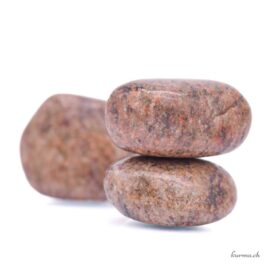
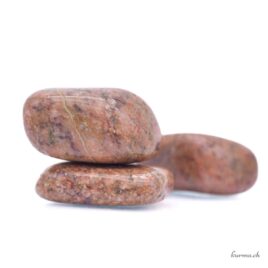
Aplite, a very fine-grained intrusive igneous rock, consists mainly of quartz and alkali feldspar.
The refined crystalline structure of this stone—which is uncommon in lithotherapy—links it to the regulation of balance and protection.
What are the properties and benefits of aplite in crystal healing?
Symbols and properties
It was identified relatively recently, in the early 19th century, by the German mineralogist and geologist Karl Cäsar von Leonhard. It is therefore not linked to myths and beliefs rooted in ancient cultures—its spiritual powers and ritual uses stem from the modern practice of lithotherapy.
Lithotherapy meanings
Modern energy practices associate this stone with properties related to mental clarity and stimulating the imagination, as well as energy regulation and protection.
Serving as a talisman, its delicate and simple structure allows it to act as an energy filter, blocking harmful influences that might arise from a toxic environment. In this sense, it is said to be particularly useful for preventing and protecting oneself against unpleasant encounters while traveling or visiting an unfamiliar place.
Its emotional and mental benefits will strengthen courage and foster an honest perspective, as well as an understanding of all the future challenges that require confidence and long-term clarity.
This support for the ability to make sound decisions also applies to mental clarity and the imagination: its effect on creativity will, in crystal healing, foster a clear understanding of analogical powers and symbols, which could be very useful for intellectual or artistic work.
In meditation and self-exploration
Whether in meditation or when working with the chakras, the spiritual properties of aplite can help precisely channel subtle energies.
Its ability to harmonize the body’s energy flows can help, through its stabilizing and grounding properties, to connect us to forces that are as unfathomable as they are formative; using it allows the power of mystery to work its magic, transforming us or helping us gain a new perspective by challenging our assumptions.
Physical Benefits
The physical effects of aplite have not been scientifically validated and are instead based on modern esoteric beliefs related to crystallography and the principles of vibrational resonance.
According to oral traditions and energy practices, this stone is known for helping to balance hormonal imbalances in adolescents and for stimulating cognitive abilities during periods of stress and mental overload.
It may also soothe excessive sexual tension, bringing balance to one’s understanding of desire and sensuality.
Which crystals go well with aplite?
In crystal healing, to enhance its effects, the symbolic energetic correspondences of aplite allow it to be paired with complementary stones depending on one’s intentions:
- Amethyst, which is associated with the imagination and promotes intuition, can clear the mind and stimulate creativity
- Combining it with Labradorite, the stone of light, can provide additional emotional protection by absorbing negative energies and promoting calm
- Schorl or black tourmaline will enhance the protective and balancing properties of aplite.
Purification of Aplite
Reloading / cleaning
Exposure to the sun/moon, running water, fumigation, breath/wind, intention, singing bowl, form wavesAstrological signs
Taurus, Virgo, Capricornstructure and stable nature
Chakras
Root chakra (Muladhara)safety, stability
Crown chakra (Sahasrara)
mental clarity, spiritual connection
Elements
Earthdepth and grounding
Mineralogy of Aplite
Its name, which comes from the Greek word *haploos*, meaning “simple,” refers to its pure mineral composition.
Often associated with granites and pegmatites, aplite is a magmatic (by origin), igneous (by solidification), and intrusive (formed below the surface) rock with a very fine grain. It consists mainly of quartz and alkali feldspar (orthoclase, microcline, and sometimes plagioclase), forming during the final stages of crystallization of granitic magmas. It may contain accessory minerals such as muscovite, biotite, topaz, fluorite, garnet, or tourmaline.
It is said to have an equigranular texture (its crystals are all similar in size, and slow, steady cooling gives it a uniform appearance) and to be saccharoid (in reference to its appearance and the luster of crystallized sugar).
It is found in North America, Northern Europe, Asia, and South Africa.
Its hardness on the Mohs scale is 6.5—which places it in the category of hard rocks. It is, however, slightly less hard than quartz.
Reproduction in whole or in part of this content is prohibited. More info