

Bismuth
, 14g–101g
Bismuth (Bi) is a native element and one of the heaviest known stable elements.
Long mistaken for tin or lead, this spectacular mineral is, in crystal healing, a symbol of creative transformation and the transition to a new state.
What are the meanings and benefits of bismuth in crystal healing?
In crystal healing, bismuth supports transitions, spiritual transformations, creativity, and metamorphosis.
Symbols of Bismuth
Bismuth was not identified as a mineral until relatively late—in the 18th century.
However, it was known to the Incas, who were already using it in bronze alloys of unusual color to increase the hardness of tools and ritual objects.
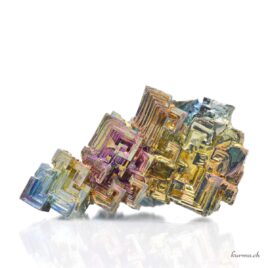
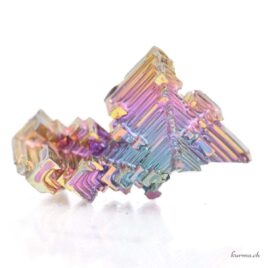
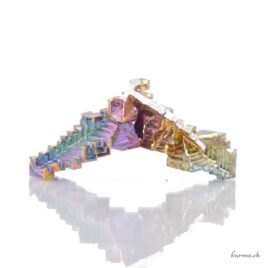
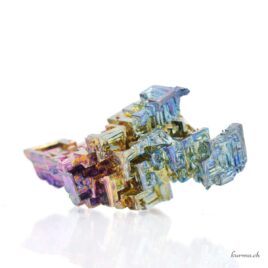
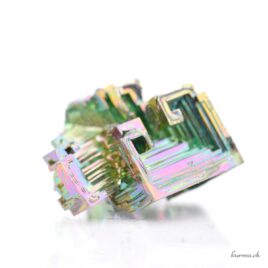
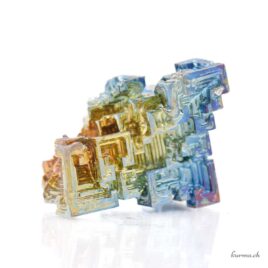
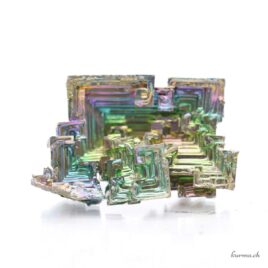
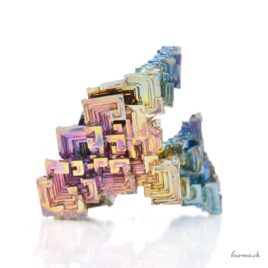
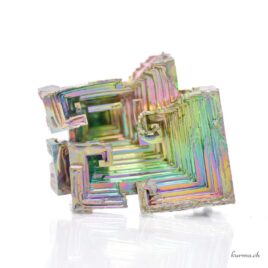
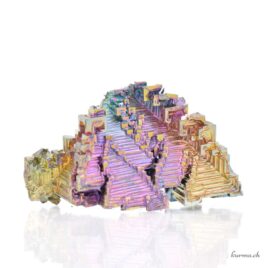
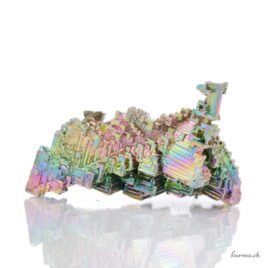
Today, its iridescent crystals, arranged in geometric, stair-step structures, symbolize all forms of spiritual transformation. Undoubtedly, its aesthetic—which evokes modern science fiction imagery—also explains its association with creative work.
Which month is associated with Bismuth?
In contemporary traditions, bismuth is associated with the month of January because of its connection to the motivation to bring about change, transitions, and new cycles.
What are the spiritual benefits of crystal healing?
In crystal healing, the geometric structure of bismuth is interpreted as a symbol of the mind’s organization and progression.
From this perspective, it can provide support during external transitions (such as moving or changing jobs), as well as during moments in life when life itself feels like a passage, a transformation, or a metamorphosis—a new beginning that is richer and wiser.
Creativity
In crystal healing, bismuth is associated with the mental calm necessary to stimulate the imagination, helping to bring clarity to mental focus and inner organization.
Alchemy asserts that creativity, like the metamorphosis of the mind or matter, is driven by two complementary forces: dissolution and condensation; art consists of separating, dissolving, and volatilizing what is solid, then condensing, fixing, and uniting what is volatile. Solve et coagula: through calm, imagination, and concentration, separate ourselves from what does not belong to us, then reconcile our opposites through action into a new form.
Building a Connection
Its paradoxical chemical nature is reflected in its symbols: bismuth is a heavy metal, yet it is diamagnetic—that is, repelled by magnetic fields. Thus, by analogy, esoteric tradition may attribute to it a power of support: for those who wish to break free from loneliness or to foster cohesion within a group.
Placed on a desk or in a creative space, the stone helps organize thoughts and reduce distractions.
Which gemstones go well with bismuth?
The combinations with other stones and crystals recommended in crystal healing are based on symbolic complementarity, depending on the desired benefits:
- Combined with soothing amethyst to foster a calm mind that is attuned to one’s creative intuition
- Combining it with fluorite or fluorine can help support mental organization
- Labradorite, a protective stone, offers support during times of change and protects against emotional overload
- Sodalite, with its spirit of openness, can foster open communication within a group and promote cohesion.
On the Hardness of Bismuth and Its Association with Other Minerals
Bismuth has a hardness of (2–2.5) on the Mohs scale—which means it can be scratched by the stones we recommend pairing it with: Amethyst (7), Fluorite (4), Labradorite (6–6.5), or Sodalite (5.5 to 6). Handle with care!
Reload and clean
How do you purify bismuth?
With a soft, damp cloth and immediate drying / form waves (Flower of Life or sacred geometries) / smudging (sage or incense) / resting in soft light on a druse, cluster, or quartz geode / singing bowl, Tibetan bells, or tuning fork / Under the moonTreatments to avoid
Do not leave the device submerged in water for long periods or expose it to prolonged moisture / avoid salt and saltwater / be careful of temperature shocks.
Chakras
Crown Chakra - Sahasraraclarity, higher consciousness, mental transformation
Third Eye Chakra - Ajna
intuition, inner vision
Astrological signs
Aquariustransformation, innovation, collective thinking
Lion
creative drive
Element
Ethertransformation, subtle states of consciousness
Mineralogy of Bismuth
Natural bismuth crystals are rare and often lack remarkable structures. As a result, most are grown in a laboratory. Iridescent crystals are produced by the controlled cooling of molten metal.
The element bismuth (Bi) is one of the heaviest known stable elements. It has a radioactive half-life of approximately 20 billion billion years.
Its crystal system is trigonal/rhombohedral.
Its natural color is silvery; the iridescence is the result of oxidation. This highly diamagnetic metal, which has low thermal conductivity, has a low melting point (271.3 to 271.5 °C).
It is found primarily in Bolivia, Peru, Mexico, Canada, Australia, and China.
Its hardness is 2–2.5 (Mohs), and its density is 9.78 g/cm³.
Why does bismuth form these spectacular shapes?
As bismuth cools, atoms attach more quickly to the corners and edges of the crystal, causing the edges to grow rapidly; since molten bismuth is viscous, this further slows the diffusion of atoms toward the center of the crystal; the center, meanwhile, remains hotter and solidifies more slowly.
Due to low surface tension and rapid cooling, liquid bismuth takes on angular and fractal shapes. A layer of oxide just a few nanometers thick creates an iridescent effect through optical interference.
Frequently Asked Questions
What are the benefits of bismuth?
+How can you use bismuth in your daily life?
+How do you purify bismuth?
+How do you recharge the Bismuth?
+Which gemstones go well with bismuth?
+Where does natural bismuth come from?
+Purify and Recharge Bismuth
1. Purification
2. Reloading
💡 Tip
Reproduction in whole or in part of this content is prohibited. More info