

Charoite
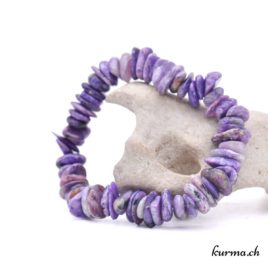
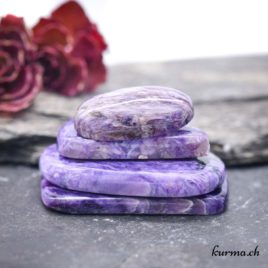
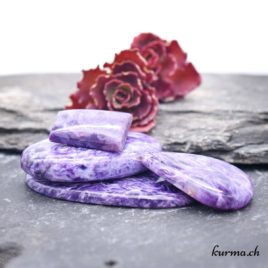
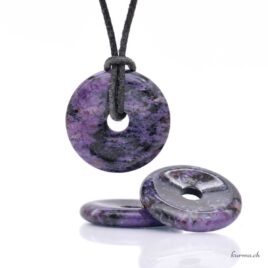
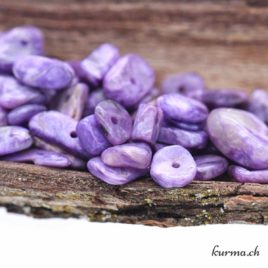
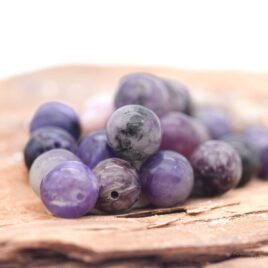
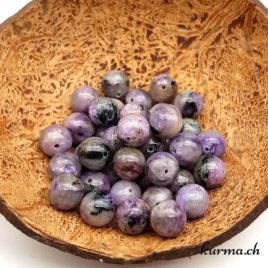
: bracelets, cabochons, tumbled stones, 925 silver pendants, donuts, beads (7–11 mm / 8–8.5 mm / 9.5–10 mm / 11 mm), A-grade tumbled stones
To date, there is reportedly only one region in the world where charoiteis found: along the banks of the Chara River in Eastern Siberia.
Charoite was not identified as a mineral until 1978. In crystal healing, it symbolizes profound transformation.
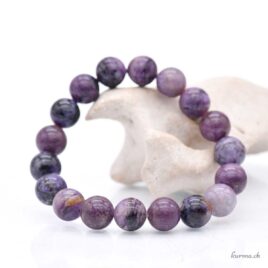
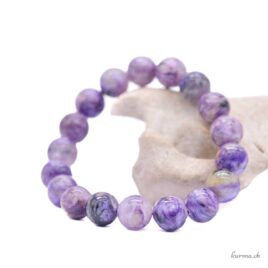
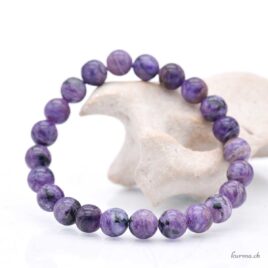
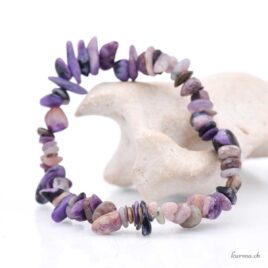



What are the virtues and properties of Charoïte in lithotherapy?
Do you ever find yourself with a mountain of unfinished tasks piling up? ... Maybe it’s just too much mental stress? Instead of procrastinating, overreacting, or panicking—and risking burnout—consider the path of Charoite!
Symbols
The name “charoite”—sometimes called “lilac stone” or “Siberian violet” in French—comes from the Chara River in Siberia, near its only known deposit to date. It was not scientifically described until the late 1970s.
Today, crystal healing regards the stone as a symbol of transformation.
Which month of the year is Charoite associated with?
Although it is not an official birthstone, it is associated with stones of wisdom and introspection: in crystal healing, charoite is linked to the month of September.
Lithotherapy meanings
The symbols associated with its purple color represent self-awareness and spirituality.
When accepting fear makes it possible to overcome it, the symbols of charoite will make this stone a guide through changes in the way you perceive the world.
Thus, it can be very helpful during times when your instincts and reflection tell you that a transition is needed to break free from limiting emotional patterns.
By supporting intuition and introspection, it will help you find courage amid the fog of thoughts. It can ease the stress of a mind seeking to know itself better and understand its relationships through meditation. And while not all emotions are easy to confront, understanding them will help you grow in maturity.
Day by day
That is the power of this stone: it gives you the drive, courage, faith, and determination you need to climb your mountain. By changing your perspective, unexpected resources may reveal themselves.
By helping you ease your stress and soothe your anxieties, fears, and worries, Charoite is a welcome ally during those moments in life when uncertainty takes over, when storms are brewing, and when the waves grow menacing. When faced with anxiety, it acts as a shield. You can face whatever comes your way by being your own guide—not a puppet of your fears.
With it, you take the risk of learning that the present moment is the perfect moment. Charoite is a stone of transformation; it can be your guide on your journey of self-discovery; for example, by inviting you to free yourself from the projections and transference that unconsciously govern relationships, to break out of the prison of Karpman’s triangle (as described in transactional analysis), and to fully reclaim your own free will. In other words, by learning to see with your own eyes.
On a physical level
There is no scientific evidence that charoite has any physical effects; rather, there is a symbolic and esoteric tradition: charoite is said to soothe and strengthen the nervous system, which may alleviate nerve-related pain. It may also reduce fever and help strengthen the heart muscle. According to the theory of energy bodies, it is said to strengthen the etheric body, making us less vulnerable to illness and “energy attacks.”
How to use a Charoïte?
Place a Charoïte under your pillow if you have trouble sleeping due to excess stress.
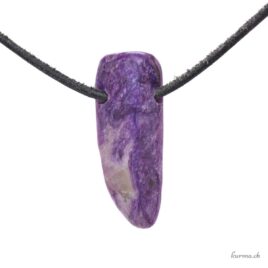
To enjoy its benefits every day, carry a charoite with you—in your pocket or as a piece of jewelry.
Carry a charoite with you during your visualization sessions, meditations, or shamanic journeys to heighten your perceptions.
Where to place a Charoïte?
In a treatment room, especially when working with the unconscious.
In your bedroom, to help you sleep better or if you want to remember your dreams.
Which stones go well with charoite?
To gain stability, protect yourself energetically, or to guide and support a period of introspection, you can pair it with black tourmaline, obsidian, or shungite.
To enhance your perceptions—particularly your intuition and clairvoyance—to work on your dreams, or when experiencing intense stress, combine charoite with white selenite.
Note: Regarding the hardness of charoite and its combination with other gemstones
Charoite has a hardness of 5 to 6 on the Mohs scale. Among the stones we recommend pairing with it, it can scratch white selenite (2), shungite (3.5 to 4), and obsidian (5 to 5.5), and can be scratched by black tourmaline (7 to 7.2). Kûrma cannot stress enough how important it is to handle your gemstones with care.
Purifying a Charoite
Refilling and cleaning
Moon / soft sunlight / earth / smudging (sage, incense, palo santo), running water (flowing quickly), breath, intention, quartz geode or selenite slab / singing bowl / form waves / prayers…Treatments to avoid
Prolonged exposure to sunlight or extreme heat / prolonged immersion in water / steam or ultrasonic cleaning / harsh chemicals.
Chakras
Sahasrara (crown chakra)the connection between the color purple and spirituality, connections, and contemplative dimensions
Ajna (third eye chakra)
intuition, inner vision, meditation
Astrological signs
Sagittariussearch for meaning, philosophical openness
Scorpio
Transformation and Renewal
Fish
intuition, sensitivity
Aquarius
openness, new perspectives
Element
AirEther (Akasha, in the Indian tradition)
Charoite mineralogy
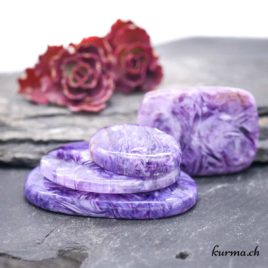
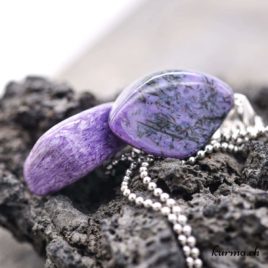
Known for its swirling patterns created by the intertwining of mineral fibers, charoite is one of the rarest ornamental minerals in the world.
Charoite is a particularly complex phyllosilicate, very rich in various minerals—and containing water. It formed from magma and mineral substances released from the rock approximately 100 million years ago, when the entire Muruk region in Eastern Siberia was compressed and displaced several times as a result of numerous volcanic eruptions. The minerals were then melted and dissolved, and new igneous and metamorphic rocks were formed. Charoite originated in the contact zone between these two types of rock. The process by which it forms is called “metasomatism” (a change in a rock’s chemical composition).
Its fibrous layers are the result of its formation through pressure and tectonic movements.
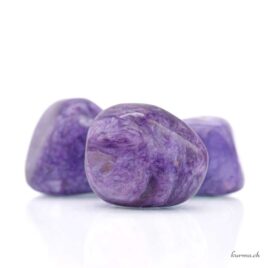
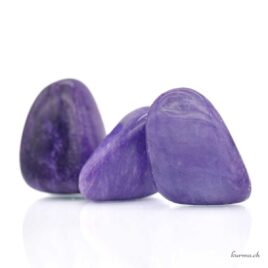
Its colors include gray, violet (due to the presence of manganese), purple, light brown, or gray. It may also feature black areas and/or green highlights.
It crystallizes in the monoclinic system. Its luster ranges from vitreous to silky, and its transparency from translucent to opaque.
Its hardness is 5 to 6 on the Mohs scale. Its density is approximately 2.54. Its structure consists of fibrous and massive aggregates.
Lithotherapy
- Element(s) :
- Zodiac(s) :
- Capricorn, Sagittarius, Scorpio
- Purification :
- Singing bowl, Water, Fumigation, Moon, Form waves, Breath, Earth
- Physics :
- Cardiovascular (System), Nervous (System)
- Emotional :
- Anguish, Emotional hurt, Courage, Self image, Nervousness, Fear, Procrastination, Stress
- Spiritual :
- Shamanism, Subtle worlds (connection), Meditation, Transformation
- Disorder(s):
- Burn-out, Depression
Mineralogy
- Hardness :
- 5.0-6.0
- Moths scale:
- 5, 6
- Strunz classification :
- Silicate
- Crystalline system :
- Monoclinic
- Chemical element :
- K, Ca, Si, O, H
- Line color :
- White
- Density :
- 2.68
- Cleavage :
- Perfect
- Fracture:
- Irregular
- Transparency :
- Translucent to opaque
- Refringence :
- Np = 1.550, Nm = 1.553, Ng = 1.559
- Birefringence :
- Δ = 0.009; negative biaxis
- Pleochroism :
- Rose
- Fluorescence :
- Slight
- Colors :
- Violet, lilac, brown
- Radioactivity :
- yes
Frequently Asked Questions
What are the spiritual benefits of charoite in crystal healing?
+How do you use charoite in crystal healing?
+Where should you place charoite in your home or workplace?
+Is charoite a rare gemstone?
+Puple love
*Please note! Some minerals may be toxic and must not be licked or ingested (as such or in the form of powder, elixir or stone water) or be in prolonged contact with the skin or mucous membranes.
*The information on the stones described here are general indications based on our research and experience, and are not exhaustive.
Reproduction in whole or in part of this content is prohibited. More info