

Manganocalcite
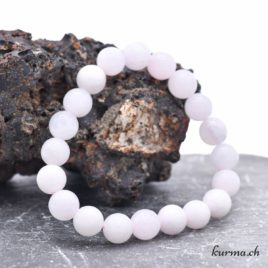
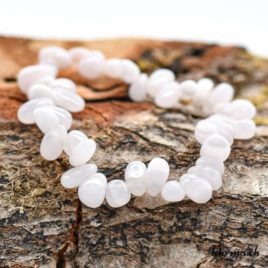
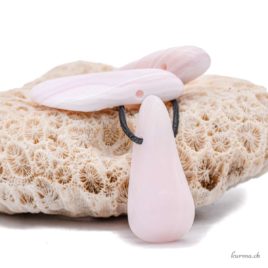
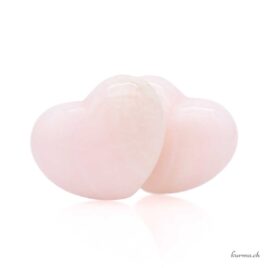
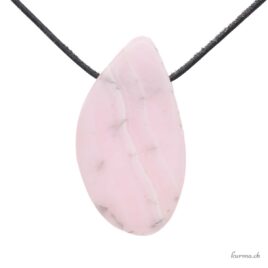
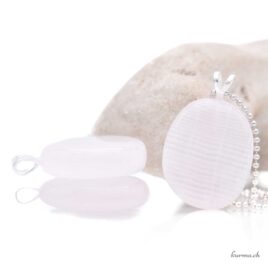
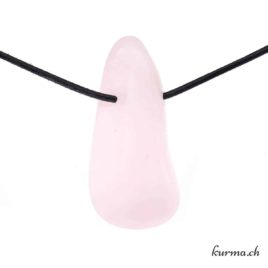
gemstones, bracelets, pendants in 925 silver or with pierced stones, hearts, rolled stones
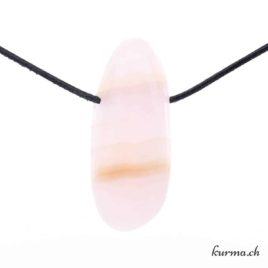
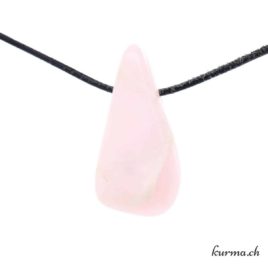
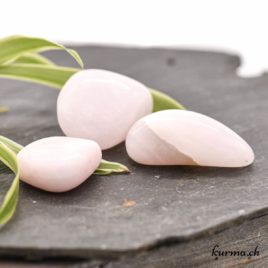
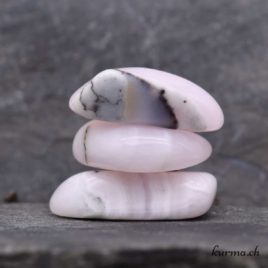
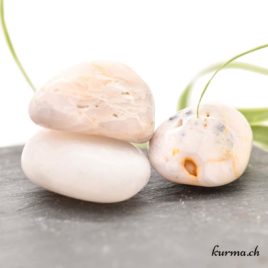
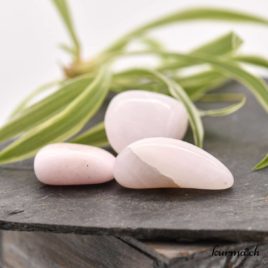
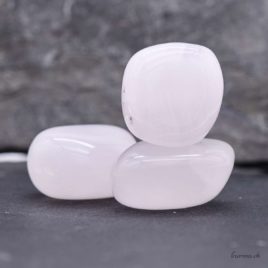
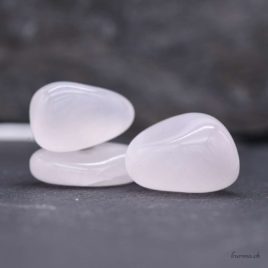
Manganocalcite differs from other calcite varieties in its concentration of manganese, which gives it its pale to deep pink hue.
In lithotherapy, it's the cuddly stone par excellence; soft and comforting, it soothes bruised hearts.
What are the properties and virtues of Manganocalcite in lithotherapy?
Manganocalcite symbols and meanings
Manganocalcite, or manganese pink calcite, was discovered in 1846 by mineralogist A. Breithaupt in Slovakia. Breithaupt in Slovakia. The origin of the symbols for this Calcium carbonate enriched with Manganese carbonate is therefore relatively recent.
On a spiritual and symbolic level, its use is developing during the 21st century in esotericism and contemporary therapeutic circles.
The meaning of its symbols associates it with gentleness, soothing and emotional healing. It speaks of compassion and acceptance, forgiveness and unconditional love.
What are its benefits?
Manganocalcite is surely the softest of stones. It's a comforting cuddle, a soft blanket, a concentrate of benevolence, gentleness and love.
It is the balm that envelops your heart, bruised by past traumas and the wounds that have scratched it. It is the comfort for the lack of love, a support on the way to acceptance and forgiveness, so that repetitive patterns cease and inner peace opens your heart to life.
Its soothing properties act on the heart chakra, encouraging emotional openness through the release of repressed emotions and self-acceptance. It affirms your right to allow yourself to be gentle: loving begins with loving yourself.
Its maternal and enveloping energy will be beneficial in lithotherapy for children upset by their emotions, as well as for adults suffering from grief and anxiety, who will be able to make peace with their childhood, with their mother.
In Manganocalcite's wisdom, there's an unconditional love where you can curl up safely. Manganocalcite can help you through transitions and learn to face the future without fear.
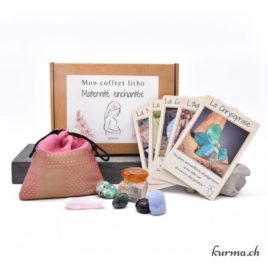
It provides welcome comfort in times of convalescence and expresses the love a young mother needs after giving birth. In this way, she is the benevolent cocoon that welcomes heartache, trauma and sadness without judgment.
What are the physical properties of Manganocalcite?
On a physical level, Manganocalcite's effects are not scientifically validated, but show a well-established tradition of supporting the nervous, endocrine and circulatory systems.
It may promote sleep and soothe psychosomatic disorders, help with eczema and skin problems, support growth, bones, nails, teeth and hair; as well as helping with inflammation related to the ENT sphere.
How to use Manganocalcite
Wear a Manganocalcite on you, preferably directly on your heart, when sadness grips your chest.
When separations with your child are difficult (school, nursery, vacations in different places...), give him a Manganocalcite to keep with him - and keep one with you.
Where to place a Manganocalcite?
Under the pillow or sheet of babies and children, to soothe their anxieties and help them sleep peacefully.
In your bedroom, to improve your sleep, or in your bath, for a moment of pure softness and relaxation.
What stones and crystals should it be paired with?
To support the effects of Manganocalcite in lithotherapy, the stone can be combined with complementary minerals according to your needs:
- Combined with Manganocalcite, Chrysoprase, the stone of Venus, can help us instinctively grasp the value of compassion and forgiveness.
- pink rock crystal will nurture tenderness and self-love
- combination with Lepidolite, a stone of transition for the mind, can help calm anxiety states
- in addition, Selenite, a fibrous or transparent gypsum, can help to make a spiritual connection.
Refilling and cleaning
How do you purify Manganocalcite?
Under the Full Moon / shape waves (flowers of life or sacred geometries) / fumigation (incense, white sage or palo santo, between 30 and 60 seconds) / singing bowl, Tibetan bells or tuning fork, natural breath/wind / intention or visualizationCare to avoid
Sensitive to humidity: avoid soaking in fresh or salt water.
Chakras
Heart chakra (Anahata)emotional healing, opening up affects
Crown chakra (Sahasrara)
spiritual connection, consciousness raising
Astrological signs
Cancersupports emotional sensitivity and security
Poisons
compassion, intuition
Balance
relational harmony, forgiveness
Elements
Wateremotions, fluidity, purification
Air
spirituality
Manganocalcite mineralogy
A variety of manganese-bearing calcite, manganocalcite belongs to the trigonal or rhombohedral crystal system, with three axes equal at more or less 90°.
Its color can vary from pale to deep pink, depending on the manganese concentration, sometimes with white inclusions or bands of pure calcite.
It can form in sedimentary environments and, more rarely, in metamorphic or volcanic contexts.
Its deposits are found mainly in Peru, Romania, Slovakia and the United States.
It has a hardness of 3 on the Mohs scale - a relatively soft stone.
Lithotherapy
- Element(s) :
- Zodiac(s) :
- Capricorn, Taurus, Virgo
- Purification :
- Singing bowl, Water, Fumigation, Moon, Form waves, Breath, Earth
- Physics :
- Hair, Tooth, Throat, Nails, Ears, Bone, Skin, Skeleton
- Emotional :
- Love, Emotional Injury, Self-confidence, Self-image, Self-respect, Resilience, Trauma, Sadness
- Miscellaneous :
- Childbirth, Convalescence
Mineralogy
- Hardness :
- 3.0
- Moths scale:
- 3
- Strunz classification :
- Carbonate and Nitrate
- Chemical element :
- Ca, C, O
- Line color :
- White to colorless
- Density :
- 2.8
- Cleavage :
- On {1011}
- Fracture:
- Spathic (stepped) to conchoidal
- Transparency :
- Transparent, translucent to opaque
- Refringence :
- nω = 1.640 - 1.660, nε = 1.486
- Birefringence :
- Uniaxial (-) δ = 0.1540-0.1740
- Fluorescence :
- In orange, yellow, pink or blue
- Colors :
- Pale pink
- Magnetism :
- no
- Radioactivity :
- no
Other soothing stones
*Please note! Some minerals may be toxic and must not be licked or ingested (as such or in the form of powder, elixir or stone water) or be in prolonged contact with the skin or mucous membranes.
*The information on the stones described here are general indications based on our research and experience, and are not exhaustive.
Reproduction in whole or in part of this content is prohibited. More info