

Thulite (pink zoisite) and
bracelets, necklaces, pendants made from drilled stones or 925 silver, rough and stones
Thulite and piemontite are two stones that are chemically very similar but have different crystal structures.
Sometimes they can mix together: if thulite is rich in piemontite, it is referred to as rosaline.
In lithotherapy, Thulite acts on the expression of emotions, while Piemontite acts on the restoration of inner strength.
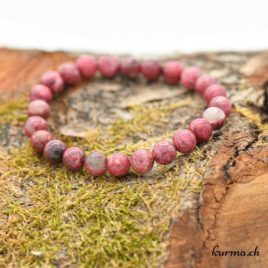
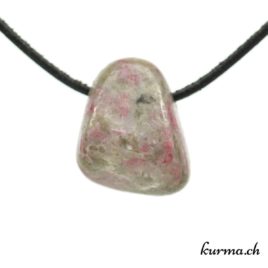
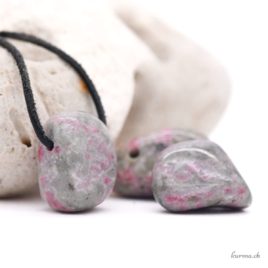
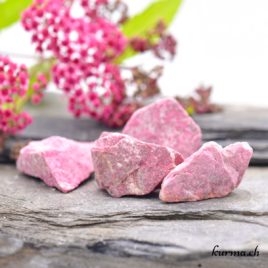

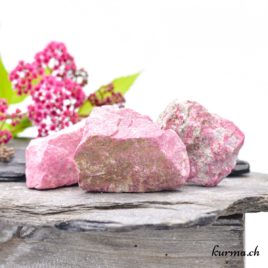
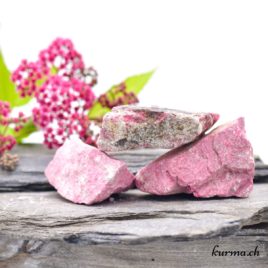
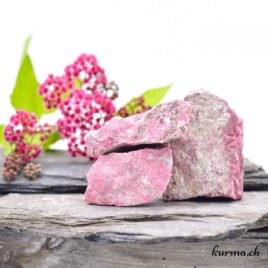
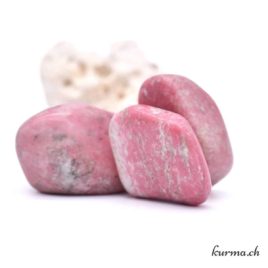
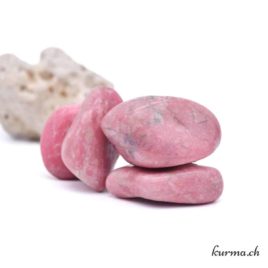
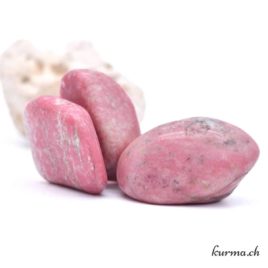
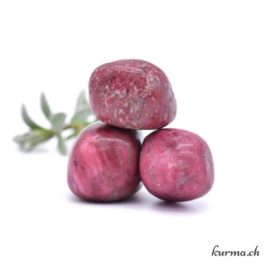
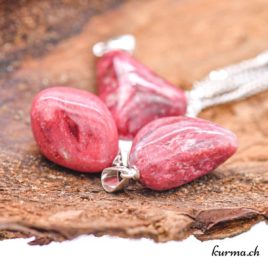
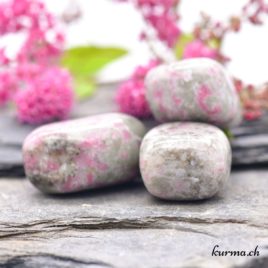
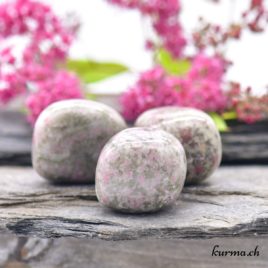
What are the meanings and and Thulite and Piemontite in crystal healing?
Emotional communication – Personal expression – Self-image issues – Self-confidence – Openness to others – Creativity – Vital energy – Sexuality – Sensuality
Piemontite
Transformation of the mind – Resilience – Courage – Mental strength – Recovery from trauma – Emotional grounding – Stability
Thulite is a pink variety of zoisite, colored by manganese, sometimes called "manganese zoisite" or "rosaline" when it is very rich in piemontite. The latter is a similar species, but from the epidote group. The difference in the structure of their crystals finds its equivalence and in lithotherapy: Thulite is more concerned with supporting more open communication linked and expression, creativity and sexuality, while Piemontite supports the courage to change, resilience, mental strength, and .
Symbols
The name Thulite comes from "Thule," a mythical island in northern Europe mentioned in major ancient Greek sources—those of Pytheas of Massalia (4th century BC), who speaks of "where the sea becomes like a marine lung " (a metaphor for the ice floe), in Strabo's Geography (1st century BC – 1st century AD), or in Pliny the Elder'sNatural History IV (1st century AD), which states: "Thule is the most distant of all known islands."
However, the identification of the mineral thulite is relatively recent, due to the Norwegian mineralogist Anders Gustaf Ekeberg in 1820, who named it as a romantic tribute to the mythical land described by Pytheas, whose discovery symbolically identifies it with Norway and with any actual place.
As for piemontite, sometimes called "manganese epidote" or "Mn clinozoisite," it owes its name to the Piedmont region of Italy, where it was first described in 1853.
In the West, both stones are associated with the month of July, due and their pink to red color for Thulite and brownish and to purple for Piemontite, and their connection to the heart chakra.
Properties and
In crystal healing, these two cousins have complementary properties and :
Thulite
It will be a faithful companion for reflection and spiritual and related to how you communicate your emotions through your personal expression.
Promoting openness to others and , it can improve self-confidence and you think about the origins of your issues in relation to the image you have of yourself.
Thulite encourages you to enjoy life to the fullest. In crystal healing, it motivates you and express your wildest desires and exciting adventures. To savor every moment, every experience in all areas of life.
It celebrates and curiosity and , highlighting the importance and opening yourself and having fun. With it, you dare to step outside your comfort zone to discover ecstasy.
She can help you experience your sexuality as something natural, affirming that it is time to explore this life force and without imposing modesty and that do not belong to you.
Piémontite and (Piémontite + Thulite)
Piémontite and association with Thulite support inner transformation; it is a stone and strength and . In lithotherapy, it stimulates courage and mental and through its strong emotional grounding, a pillar of stability.
Have you ever had that unpleasant feeling of missing out on life? Have you ever had projects that were important to you, but you didn't have the energy or time to do them?
The wisdom of Thulite teaches you to overcome these obstacles and make way for the fulfillment of what inspires you.
With it, you will and surpass yourself and yourself with courage to overcome difficulties and new challenges. What is truly important to you will become clear, and will know how to draw on your vital strength and to reach your destination. Nothing and no one should take away the beauty of an experience that nourishes your spirit and the world!
Physical benefits
On a physical level, according to tradition but without scientific evidence, both Thulite and Piemontite promote fertility in women and . It can be of great support for all pathologies affecting the reproductive organs; similarly, it could provide relief in cases of endometriosis or difficult premenstrual symptoms. Particularly stimulating for the whole body, in lithotherapy Thulite increases vital energy and the nervous system.
How to use Thulite or Piemontite in crystal healing?
- To improve fertility and in cases of reproductive organ disorders, tradition dictates wearing a thulite stone on the pubic bone every day—a pendant with a cord would be ideal.
- Do you want to finally live your life to the fullest? Do you feel tired or weak? Carry the stone with you every day.
- An improv match? A public speech? Take a Thulite with you, and you may be surprised to discover your incredible inventiveness.
Where to place a Thulite?
Which stones and can be combined with thulite or piemontite?
Through synergy, your stones can be combined with other minerals in lithotherapy according to your emotional or energetic needs:
Thulite
- Combining it with aquamarine crystal or blue beryl will support fluidity of expression and calm anxiety by clarifying emotions.
- For its contribution to your emotional structure and healing and emotional wounds, you can combine Thulite with Rhodonite crystal to repair your emotions.
- The addition of the tenderness of rose quartz to thulite fuels self-love.
Piemontite
- To exceed your limits,iron- or manganese-bearing epidote will support personal transformation, growth, and spiritual maturity.
- To boost courage and , pyrope or almandine garnet will be a powerful spiritual asset.
- Through its powers of transmutation, smoky quartz will help to release fears and provide grounding.
On the hardness of thulite and and combination with other minerals
Thulite has a hardness of between 6 and .5 on the Mohs scale. Among the stones we recommend pairing it with, it can scratch or be scratched by Rhodonite (5.5 to 6.5) and scratched by Aquamarine (7.5 to 8) or Rose Quartz (7).
Piemontite has a hardness between 6 and on the Mohs scale. Among the stones we recommend pairing it with, it can scratch Epidote (6 to 7), Garnet (6.5 to 7.5) and Smoky and (7).
The utmost care is advised!
Refilling and cleaning
How to purify Thulite or Piemontite?
Moonlight / distilled water, avoiding prolonged immersion, or with a soft damp cloth, drying immediately / shape waves (flowers of life or sacred geometries) / fumigation (white sage, incense, or palo santo) / resting on a cluster of quartz or amethyst / sound method: singing bowl, Tibetan bells, or tuning forkTreatments to avoid
Intense exposure to sunlight can discolor it / abrasive products and harsh and / salt
Chakras
ThuliteHeart chakra (Anahata), throat chakra (Vishuddha)
Piemontite
Root chakra (Muladhara), solar plexus chakra (Manipura)
Astrological signs
ThuliteCancer, Libra, Gemini
Piemontite
Scorpio, Capricorn, Aries
Elements
ThuliteAir, water
Piemontite
Fire, Earth
Mineralogy of Thulite and Piemontite
Although thulite and share a similar chemical composition, their crystal structures differ—orthorhombic for the former, monoclinic for the latter.
Thulite is a pink variety of zoisite (Ca₂Al₃(SiO₄)(Si₂O₇)O(OH)) in which manganese partially replaces aluminum. It forms during the conversion of manganese-bearing rocks into silicate rocks through contact metamorphism. For its formation, the presence of water and high and are essential.
It is found mainly in Norway, Austria, Australia and South Africa.
Piémontite is a species belonging to the epidote group (Mn³⁺-rich clinozoisites), with the formula Ca₂(Al,Mn³⁺)₃(SiO₄)(Si₂O₇)O(OH).
It is found in low- to medium-pressure metamorphic schists, most often associated with quartz, chlorite and . It is present and Piedmont (Italy), Andros (Greece), Japan and .
Both minerals can coexist in manganese-rich metamorphic assemblages. They can be found together, mixed with Quartz and . "Rosaline" is the name used for Thulites that are very rich in Piemontite.
Thulite has a hardness of 6/6.5 on the Mohs scale. Piemontite has a hardness of 6/7.
Lithotherapy
- Element(s) :
- Zodiac(s) :
- Cancer, Gemini, Pisces
- Purification :
- Singing bowl, Water, Fumigation, Moon, Form waves, Breath, Earth
- Physics :
- Fatigue, Nervous system, Reproductive system, Female reproductive system, Male reproductive system, Painful periods, Vitality
- Emotional :
- Action, Love, Courage, Desire, Joie de vivre, Pleasure
- Spiritual :
- Meaning of life
- Miscellaneous :
- Creativity, Fertility, Libido, Menstruation, Sexuality
Mineralogy
- Hardness :
- 6.0-6.5
- Moths scale:
- 6
- Strunz classification :
- Silicate
- Chemical element :
- Ca, Mn, Al, O, H, Si, Ba, Cr, Fe, Mg, Sr
- Line color :
- White
- Density :
- 3.25-3.36
- Cleavage :
- Perfect
- Fracture:
- Unequal
- Transparency :
- Opaque to translucent
- Colors :
- Red (often mixed with white or grey parts), pink to pinkish-purple, pinkish-green
Other stones for fertility and sexuality
*Please note! Some minerals may be toxic and must not be licked or ingested (as such or in the form of powder, elixir or stone water) or be in prolonged contact with the skin or mucous membranes.
*The information on the stones described here are general indications based on our research and experience, and are not exhaustive.
Reproduction in whole or in part of this content is prohibited. More info