

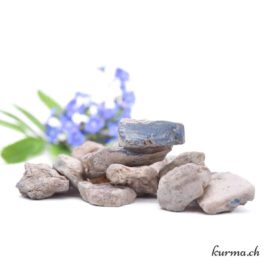
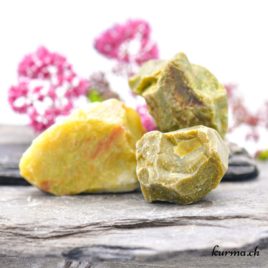
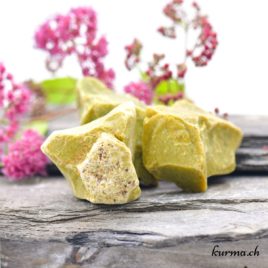
green opal rough stonesfrom Madagascar, blue and from Australia
Raw opals are minerals—consisting mainly of silicon dioxide—with a proportion of water trapped in their structure.
The stone is a symbol of fluidity in lithotherapy, amplifying exciting and emotions, such as joie de vivre and of the spirit.

How to choose the right raw opal stone?
Symbols and benefits
For the Aboriginal people of Australia, the "rainbow serpent" stone originated in these colors of the sky.
In North Africa, she was a portion of lightning trapped by rock. Arab legends told that she fell from the sky among the lightning bolts.
In ancient times, in the West, opal already captivated people with its beauty and ; it was considered a stone that combined the spiritual properties of all stones. It symbolized purity, prophecy, optimism, love, protection and .
Today, contemporary lithotherapy uses it and an adjuvant and the metamorphoses of the mind with its fluid energy. Its mystery is a source of balance, flexibility, and creativity.
Opal is the birthstone for the month of October.
Meaning and virtues in lithotherapy
Its properties are sacred and poetically and . To experience its mystery is to embody ancestry by listening to your intuition, revealing your emotions and and feelings and creativity.
It invites movement as much as it does surpassing oneself. Emotions, projected onto action, can open your eyes to your imaginary limits, inhibitions that prevented you from living life to the fullest.
The transcendence of opal is thus closely linked to an amplification of sensitivity and its message and for renewal. Its accompaniment can be useful in overcoming blockages arising from unresolved psychological issues, healing your wounds, and embarking on the path to conscious presence in the world, allowing yourself joy, freedom, and .
Our varieties of rough opals
There are many different varieties of opals. While our rough opals all share the characteristics we have listed, some may have additional unique features:
Blue opal
Among its symbols and in lithotherapy, the most significant are its enlightening and properties. Blue opal will accompany thoughts that put perceptions and into perspective, soothing pain with its pure and energy.
To learn more about the symbols of blue opal.
Green opal, pistachio, or kiwi
Its symbols and link it to the energies of springtime and new beginnings. Its energy supports a stimulating life, helping to regenerate in cases of mental and exhaustion.
You can discover in detail the revitalizing benefits of green opal.
Which stones or crystals should you pair with your raw opal?
Your raw stone can be accompanied by other stones and in lithotherapy. Through an energetic synergy effect, their combination can intensify its action depending on the desired properties:
- Raw blue opal combines very well with raw aventurine quartz to control heightened sensitivity, which manifests itself, for example, in excessive shyness. To reinforce the peace and of blue opal, raw larimar will soothe you with its gentle energy.
- Raw green opal can be combined with citrine or raw yellow quartz, which supports luck and with its vitality. Raw nephrite or serpentine jade will also support vitality, focusing on wisdom and .
Refilling and cleaning
How to purify a raw opal?
Expose to the full moon / soft, slightly damp cloth, quick drying / waveforms (flowers of life, sacred geometries) / fumigation (white sage, incense) / rest on an amethyst geode / singing bowl, Tibetan bells, or tuning forkTreatments to avoid
Avoid: ultrasound, steam, intense heat, acids, abrasive products, chemicals, prolonged immersion, impacts
Chakras
Heart Chakra, Anāhataopenness and emotional and
Astrological signs
Blue opalPisces, Libra, Gemini
Intuition / Sensitivity / Clarity of mind / Communication / Harmony
Green opal
Libra, Scorpio, Taurus
balance, harmony, stability / intensity of emotions, transformation / relationship with nature
Elements
Blue opalWater
fluidity, purification
Air
Lightness, subtle worlds
Green opal
Water
fluidity, purification
Earth
Balance, grounding
Mineralogy of our rough opals
Blue or green opals are common opals, composed of hydrated silicon dioxide, without any marked iridescence.
Their structure is amorphous, sometimes partially crystalline, but unorganized. It is formed by sedimentation and of amorphous silica fluids in volcanic or sedimentary rocks.
Andean opal owes its color to mineral inclusions—chrysocolla or other copper silicates.
The color of green opal can be explained by the presence of iron oxide inclusions, secondary minerals, or impurities.
Blue opal from the Andes comes from Peru, but blue opals are also found in Australia and United States.
Green opal is found in Madagascar, Australia, Brazil, Mexico, Peru, the United States and .
Handle with care
With a hardness of 5 to 6.5 on the Mohs scale for all Opals, Blue Opal can scratch Larimar and scratched by Aventurine. Green Opal can be scratched by Jade or Citrine—raw stones which we recommend above to combine with blue or green opal.
*Please note! Some minerals may be toxic and must not be licked or ingested (as such or in the form of powder, elixir or stone water) or be in prolonged contact with the skin or mucous membranes.
*The information on the stones described here are general indications based on our research and experience, and are not exhaustive.
Reproduction in whole or in part of this content is prohibited. More info