

Golden obsidian
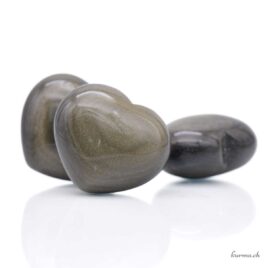
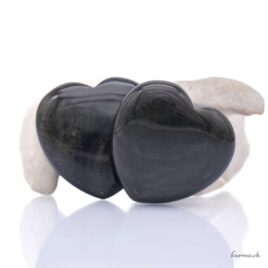
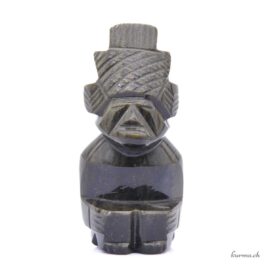
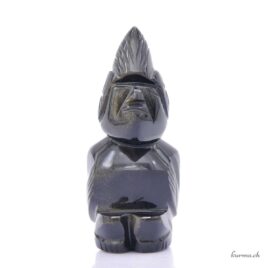
Rolled gemstones, hearts, statuettes
Golden Obsidian 's shimmering reflections come from microscopic inclusions of minerals, or sometimes gas bubbles, in the glassy volcanic rock.
In lithotherapy, it is a stone of protection and transformation.
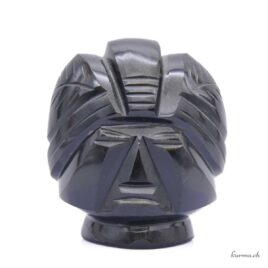
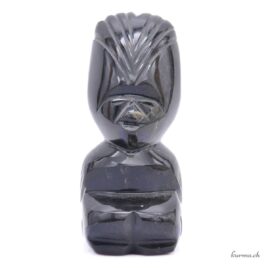
What are the properties and virtues of Golden Obsidian in lithotherapy?
Stone symbols
Like all Obsidian varieties, this golden-hued variety is derived from the rapid cooling of silica-rich lava.
In ancient times, the Aztecs and Mayans, Mesoamerican civilizations, used Obsidian to make weapons and cutting tools, conferring on it a sacred value linked to protection and power.
In ancient Rome, it's the writer Pliny the Elder who gives it its name - he mentions a certain Obsius who is said to have discovered it in Ethiopia. However, this could be another stone or a transcription error, so the etymology of its name remains debated.
Contemporary esotericism associates Golden Obsidian with the symbols of spiritual light, which reveals truth through personal transformation.
Significance and spiritual benefits
In lithotherapy, Golden Obsidian can be seen as a mystical mirror. If the stone protects and accompanies the transformations and metamorphoses of the spirit, it's by virtue of its reflections revealing the shadows and mysteries of our part of the unknown, our unconscious, whose wounds it will then be a question of healing and freeing it from its blockages through introspection.
Its energetic protection absorbs negative energies and strengthens presence in the world. It prepares the way through the vision of the horizon.
On the threshold of departure or commitment to adventure, its golden reflections symbolize the light that illuminates doubts, nurturing self-confidence and clarity of thought conducive to decision-making.
It is by overcoming fears that we can initiate profound changes with the help of the stone of metamorphosis. Golden Obsidian represents transformation and radiance, like the Phoenix rising from the ashes.
It is linked to Yang - solar energies. On the path of self-knowledge and introspection, but also in right action and with determination, it can help you discover the real source of a problem.
For whom?
It's a stone that can help introverts to expand their world and their perception, to gain self-confidence through confrontation, and to dare to shine.
On a physical level
These are not scientifically established benefits, but lithotherapy tradition attributes digestive regulation and body detoxification properties to Golden Obsidian.
What lithotherapy stones should Golden Obsidian be associated with?
Depending on the wearer's purpose, Golden Obsidian can be combined with various complementary lithotherapy stones. Synergy can help amplify its effects:
- The combination with Citrine or Lemon Quartz nourishes self-confidence and a solar energy to undertake change.
- to accompany Golden Obsidian, Garnet or Escarboucle will stimulate vitality
- Tiger's Eye Quartz will promote energetic protection and a confident will.
Refilling and cleaning
How do I purify a golden obsidian?
Exposure at Full Moon / distilled, clear or spring water / shape waves (flowers of life or sacred geometries) / fumigation (white sage or palo santo, 30 and 60 seconds) / rest on a Selenite plate / singing bowl, Tibetan bells or tuning forkTreatments to avoid
Avoid detergents, solvents, acids and abrasive cleaning products. Prolonged exposure to sunlight or sudden changes in temperature. Hard or abrasive brushes
Chakras
Solar plexus (Manipura) and root (Muladhara) chakrasself-confidence, willpower, anchoring
Astrological signs
Scorpio, Sagittariustransformation, emotional depth
Elements
Earthanchoring, stability
Light
transformation energy
Mineralogy of Golden Obsidian
Golden Obsidian is a glassy volcanic rock formed by the rapid cooling of silica-rich lavas; its golden reflections and silky appearance are due to the presence of microscopic inclusions of minerals such as Magnetite or Hematite, or to gas bubbles aligned in the mass.
Since it has no regular crystal structure, it is classified as a mineraloid in gemmology.
Its conchoidal fracture explains its ancient use for making weapons and sharp tools.
It is found in volcanic areas, particularly in Mexico, the United States, Iceland, Indonesia, the Philippines and Japan.
Its hardness ranges from 5 and 5.5 on the Mohs scale, and its average density is 2.4 to 2.6.
*Please note! Some minerals may be toxic and must not be licked or ingested (as such or in the form of powder, elixir or stone water) or be in prolonged contact with the skin or mucous membranes.
*The information on the stones described here are general indications based on our research and experience, and are not exhaustive.
Reproduction in whole or in part of this content is prohibited. More info