

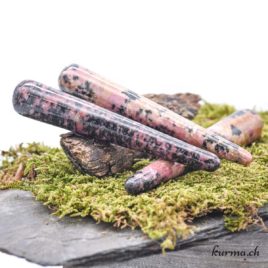
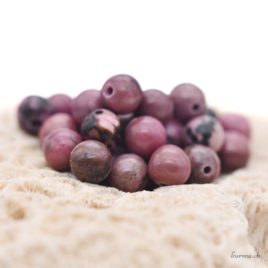
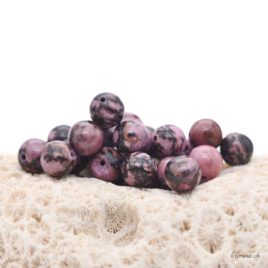
Rhodonite
Pink Manganese / Manganese Spar / Manganolite
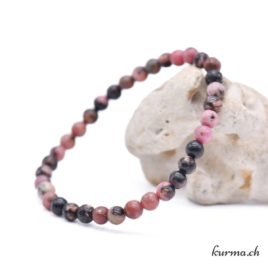
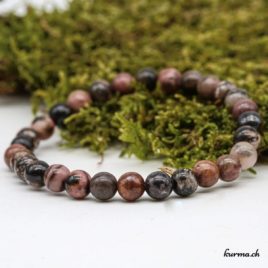
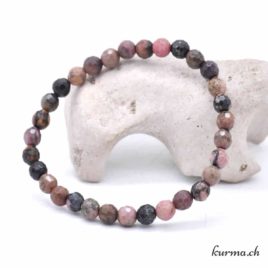
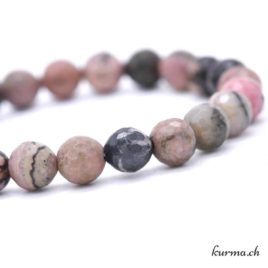
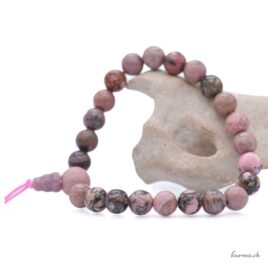
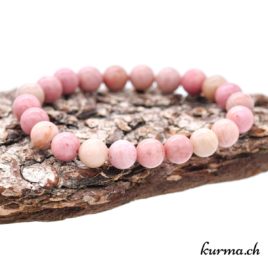
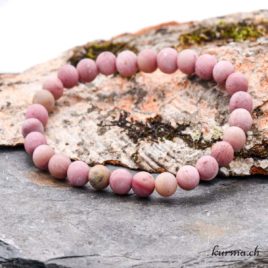
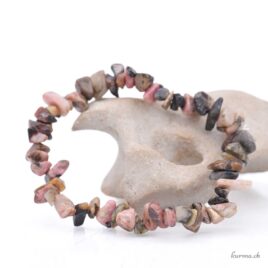
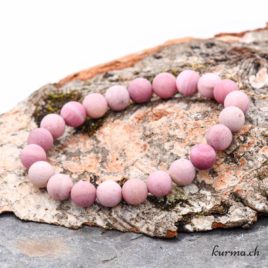
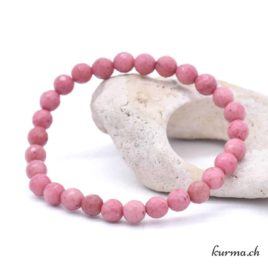
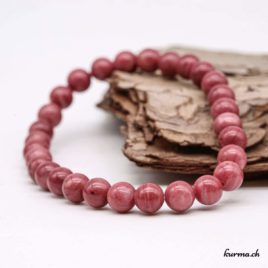
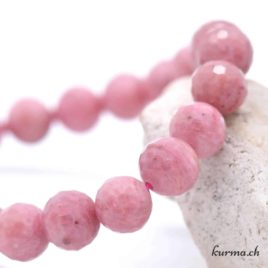
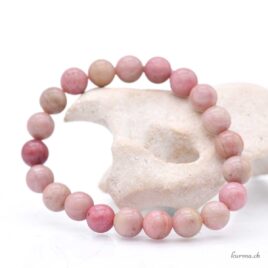
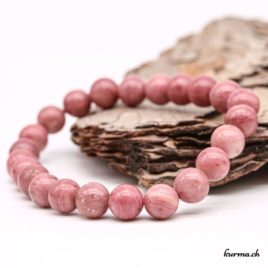
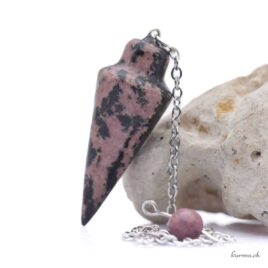
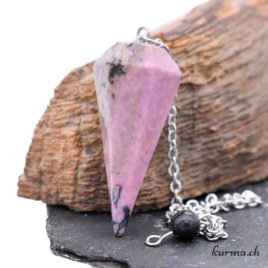
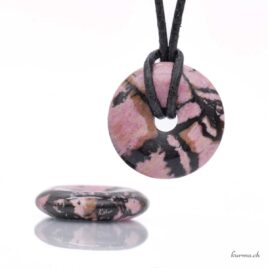
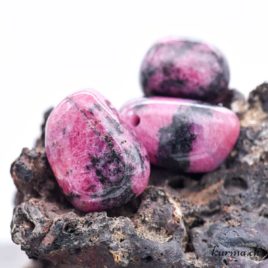
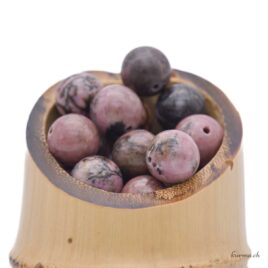
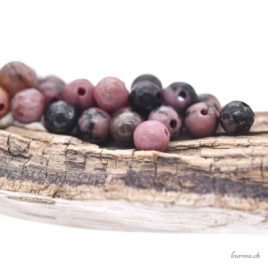
semi-precious stones, bracelets 4 mm to 10.5 mm—faceted or matte, beads 4 mm to 10 mm, tumbled stones, heart pendants,
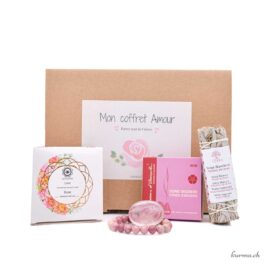
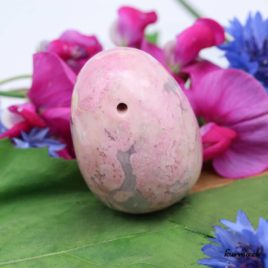
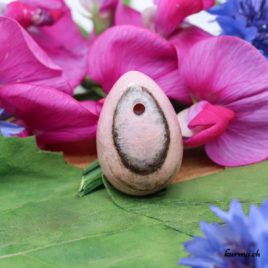
donut, 925 silver, pierced, teardrop or hexagon pendants, Yoni Eggs, anti-stress gift set
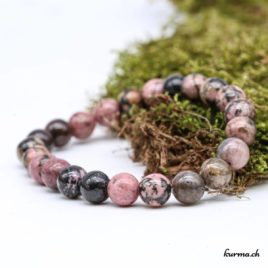
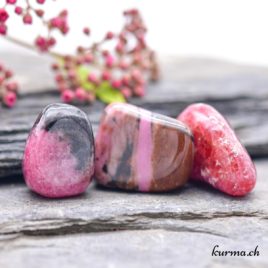
Rhodonite is a well-rounded stone that, in crystal healing, strikes a balance between its protective black veins
and the soothing properties of its deep, rich pink color.






What are the benefits and properties of rhodonite in crystal healing?
The Symbols of Rhodonite
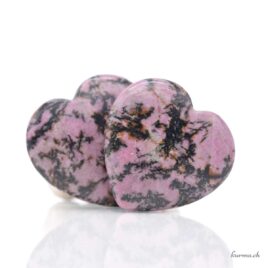
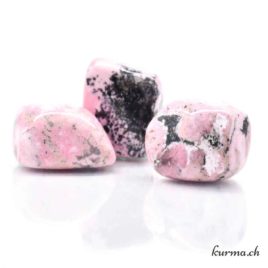
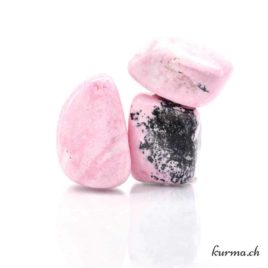
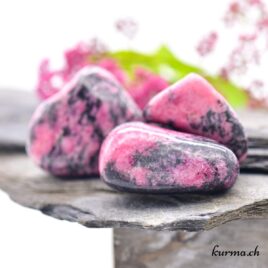
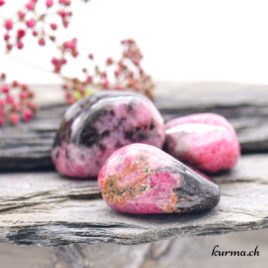
Its name comes from the Greek word *rhodon*, meaning “rose”; it is characterized by a deep pink color streaked with black manganese veins. It is sometimes called pink manganese, manganese spar, or manganolite.
Rhodonite was first described in 1819 by the German mineralogist Christoph Friedrich Jasche, director of a mining plant in Ilsenhourg.
Subsequently, following the discovery of deposits yielding massive blocks in the Ural Mountains, it became an imperial symbol in Russia, commonly used to adorn palaces and craft numerous decorative objects.
Tsar Alexander II had the entire slab for his wife’s tomb carved from a single block of rhodonite weighing… 49 metric tons! Hand-polished, it took 16 years to complete before it was installed in the cathedral in Saint Petersburg in 1906.
The current symbolism associated with rhodonite is rooted in contemporary crystal healing. It is an anti-stress stone linked to the heart, resilience, and emotional healing.
Rhodonite, the stone of the month for July
Rhodonite is associated with the month of July, primarily for three reasons:
- Its pink-red color symbolizes emotional energy: July, a month of summer and vitality, is associated with sunstones and stones linked to love. Its deep pink hue and protective black veins make rhodonite a stone that soothes, stabilizes, and supports the impulses of the heart.
- Astrological correspondences: July is ruled by Cancer (water, emotion, sensitivity) and Leo (fire, heart, expression). Rhodonite is associated with the element of Water—a metaphor for emotional fluidity—the Anahata heart chakra, and the processes of emotional healing.
- Their symbolism in crystal healing:Pink or red stones are often associated with summer; as stones of the heart, they are linked to months associated with emotions and periods of energetic transition.
Spiritual meanings and
In crystal healing, rhodonite can help heal emotional wounds. It soothes heartache and absorbs emotional tension and trauma.
Her support can help heal the pain caused by grief, breakups, and conflicts, or be beneficial for those suffering from emotional deprivation.
It can foster a clearer perspective by reducing anxiety through its inherent calm, stabilizing your emotions to help shield you from anger or other destructive impulses.
It is a call for forgiveness, understanding, and tolerance. It highlights empathy and hospitality as mature strengths that, when practiced during periods of personal growth, will help build self-confidence.
On a physical level
On a physical level, the benefits of rhodonite are not based on medical evidence, but on energetic traditions in crystal healing. In this symbolic context, it is associated with blood circulation, wound healing, and cardiovascular support. It may also help alleviate various autoimmune diseases by addressing their underlying causes, and may help promote fertility.
Day by day
When you’re going through emotionally intense upheavals—whether sorrow weighs heavily on your heart or life’s trials have left you wounded—Rhodonite supports you by offering comfort and helping you heal your wounds. It is the ultimate healing stone.
Her wisdom helps you resolve the conflicts raging within you or outside of you. She invites you to embrace forgiveness, tolerance, and understanding. With her guidance, you can gain a fresh perspective on the pain and wounds that resurface during conflicts, and take the necessary steps to heal them without letting yourself be swayed or overwhelmed by feelings of jealousy or frustration. She helps you understand the root causes and act without casting yourself as either a victim or a persecutor.
It’s a valuable ally that can help you keep your footing, stay clear-headed, and not let anxiety take over when your emotions become overwhelming and your emotional needs go unmet; when an emotional shock upsets you, when stress causes your heart to race, or when your hypersensitivity becomes too much to bear.
It can also help people who are quick to anger or who lose their temper easily to deal with their emotions in a more rational way.
How to use Rhodonite
- To treat a scar, massage the affected area with argan oil or another oil of your choice in which you’ve let rhodonites “infuse.”
- Wear the rhodonite every day directly over your heart to work on this area—whether physically or emotionally
- Carry this stone with you—in your hand, in your pocket, or as a piece of jewelry—to benefit from its stress-relieving properties
- In the event of a shock or accident, immediately place a Rhodonite on your person to help prevent the onset of trauma.
Where to place Rhodonite?
- A rhodonite in your living space will radiate soothing energies
- It's perfect for the bedroom or a space dedicated to relaxation
- in your car, if driving is stressful for you
- in yourfirst -aid kit.
Rhodonite, for whom?
- For paramedics and anyone who encounters accidents or emergencies
- for people who are anxious, often sad, or prone to anger
- for all those for whom feelings of jealousy or frustration take up too much space
- for people who suffer from emotional deprivation, hyperemotionality, or hypersensitivity.
Which stones should be paired with rhodonite?
To enhance its benefits in crystal healing, rhodonite can be combined with various other stones and crystals:
- The stabilizing energy of lepidolite crystals can help soothe anxiety and stressful thoughts
- Also pink in color, Morganite crystal will provide support during the process of forgiveness and reconciliation
- Rose quartz, a crystal associated with love, will strengthen the gentleness and self-love necessary for healing the heart
- Black obsidian, a volcanic stone, will be the perfect complement to the manganese veins in rhodonite, helping to ground, protect, and ward off negative energies.
On the Hardness of Rhodonite and Its Association with Other Minerals
Rhodonite has a hardness of 5.5 to 6.5 on the Mohs scale. Among the stones we recommend pairing it with, it can scratch Lepidolite (2.5 to 3), scratch Black Obsidian (5.5 to 6) in return, or be scratched by Rose Quartz (7) or Morganite (7.5 to 8). Handle your minerals with care!
Reload and clean
How do you cleanse a rhodonite?
Under the Full Moon / lukewarm clear water, followed quickly by a gentle wipe / form waves (Flowers of Life or sacred geometries) / smudging (white sage or palo santo for 30 to 60 seconds) / singing bowl, Tibetan bells, or tuning fork / breath / natural wind / intention / amethyst or quartz geodeCare to avoid
Avoid intense heat / chemical cleaners / abrasive scrubbing / prolonged immersion / impacts
Chakras
Heart chakra (Anahata)love, compassion, emotional balance.
Astrological signs
Ariesto curb impulsivity
Taureu
emotional stability
Capricorn
resilience, emotional discipline
Element
Wateremotional fluidity, healing of the mind
Mineralogy of Rhodonite
Rhodonite is a manganese inosilicate belonging to the pyroxenoids group. Its general formula is (Mn,Fe,Mg,Ca)SiO₃.
Its crystal system is triclinic, of the pinacoidal class.
Its colors range from pink to dark pinkish-red (manganese), very often with gray or yellow veins of spessartine and/or black veins of oxidized manganese oxide ( psilomelane, which you can find at this link).
Its luster ranges from vitreous to pearly, and its transparency from transparent to translucent. Its cleavage is perfect on {110} and good on {001}. Its fracture is conchoidal to irregular.
It occurs primarily as granular, rough masses, formed either primarily through hydrothermal processes or secondarily through contact metasomatism with manganese-rich clay sediments. It is frequently associated with tiragalloite, marturite, and manganese oxides.
Its hardness is 5.5–6.5 on the Mohs scale, and its density is 3.57–3.76.
Lithotherapy
- Chakra(s):
- Element(s) :
- Zodiac(s) :
- Aries, Capricorn, Taurus
- Purification :
- Singing bowl, Water, Fumigation, Moon, Form waves, Breath
- Caution(s):
- No
- Illness(es) :
- Autoimmune, Cardiac, Cardiovascular
- Physics :
- Cardiovascular (System), Healing, Blood circulation, Heart, Insect bite, Ulcer
- Emotional :
- Love, Anguish, Emotional injury, Emotional deficiencies, Anger, Hypersensitivity, Nervousness, Resilience, Stress, Tolerance, Trauma, Emotionality
- Spiritual :
- Protection
- Miscellaneous :
- Friendship, Caesarean section (scar), Fertility, Relationship (friendship), Relationship (love)
Mineralogy
- Hardness :
- 5.5-6.5
- Moths scale:
- 5, 6
- Strunz classification :
- Silicate
- Crystalline system :
- Triclinique
- Chemical element :
- Mn, Fe, Mg, Ca, Si, O
- Line color :
- White
- Density :
- 3.4-3.7
- Cleavage :
- Perfect
- Fracture:
- Unequal
- Transparency :
- Translucent to opaque
- Refringence :
- a=1.711-1.738, b=1.714-1.741, g=1.724-1.751
- Birefringence :
- Biaxial (+); 0.0130
- Fluorescence :
- Yes and luminescent
- Colors :
- Pink to brown, grey to yellowish
- Magnetism :
- no
- Radioactivity :
- no
Other anti-stress stones
*Please note! Some minerals may be toxic and must not be licked or ingested (as such or in the form of powder, elixir or stone water) or be in prolonged contact with the skin or mucous membranes.
*The information on the stones described here are general indications based on our research and experience, and are not exhaustive.
Reproduction in whole or in part of this content is prohibited. More info