

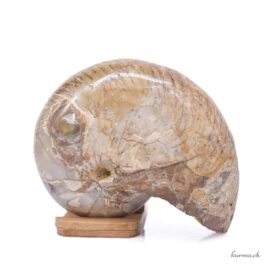
Ammonite / Ammon's Horn
—fossils, natural or polished minerals, opalized specimens, Cleoniceras, along with Orthoceras and Nautilus
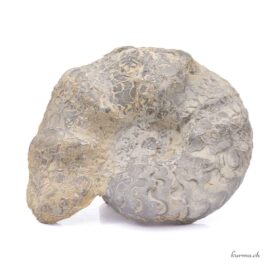
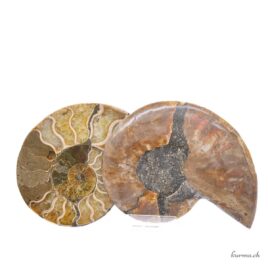
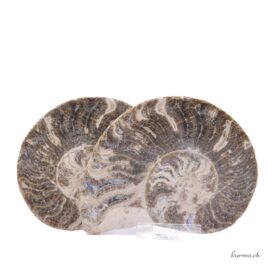
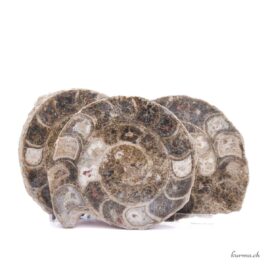
Ammonites are fossils of marine cephalopod mollusks that became extinct at the same time as the dinosaurs, 66 million years ago.
From the perspective of crystal healing, this fossil serves as a guide through a cycle, helping us work through our memories so we can live fully in the present.
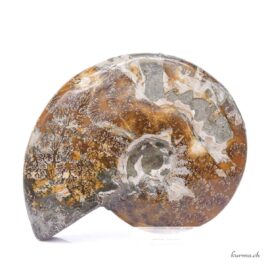
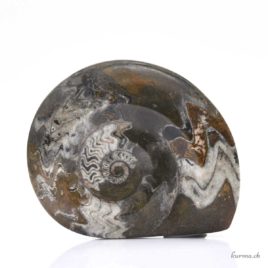
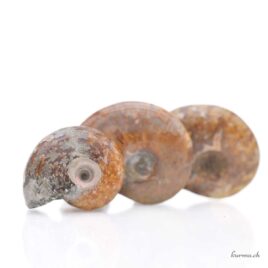
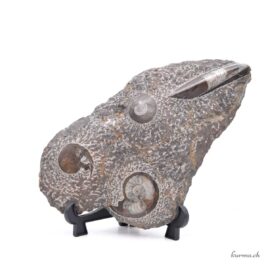
What are the symbols and properties of the ammonite in crystal healing?
In crystal healing, Ammonite is a stone that supports transformation, which it links to the cycles and memories of life, guiding those in search of vitality, stability, and harmony.
Symbols of the Ammonite
The Ammonites, which may date back 300 million years, lived between the Devonian and the end of the Cretaceous periods, before suddenly disappearing during the Cretaceous–Paleogene extinction event, following the impact of a massive asteroid on Earth 66 million years ago.
Cephalopod mollusks related to modern nautiluses by their spiral, compartmentalized shells; the shape of ammonite fossils may have reminded ancient naturalists of ram’s horns, and thus its name is said to derive from that of the Egyptian god Ammon, who was often depicted with ram’s horns.
In England, popular tradition regarded these fossilized shells as petrified snakes, known as " snakestones."
In India, a living tradition associates these extinct marine cephalopods with manifestations of Vishnu. The spiral shape of the shaligram stones found in the Kali Gandaki River in Nepal is symbolically interpreted as an expression of the cosmic chakra, the wheel of Vishnu.
Which month is the ammonite associated with?
Ammonite is associated with the month of October —its symbolic connection to transformation and cycles in Western traditions explains its association with fall.
Spiritual virtues
This stone is a call to balance vitality and stability on the path to harmonious transformation.
From a symbolic perspective, the dynamic energy of the ammonite is linked to its oceanic origin and its very long geological history.
Its spiral structure conveys the idea of balance within a cycle, incorporating a central point of origin that serves as a source of grounding and stability.
Form also signifies a harmonization of our energies through the power of their organization, using the natural geometry of its shell as a model.
Its support is emotional, helping to ease tensions and promote mental clarity when we need to move on and open ourselves up to the possibility and understanding of change.
Memory of the World
The ammonite is a stratigraphic fossil, a marker that characterizes a specific geological era. By making it possible to date the layers of a geological formation on a geological scale, the ammonite provides more than just scientific information: by connecting us to the history of the Earth and of life itself, the ammonite becomes a metaphor for a space where gentle change takes shape. It invites you to reflect on memory, on our presence, and on what we must inevitably leave behind along our journey.
Which minerals should be paired with ammonite?
Depending on the desired benefits, ammonite can be combined with other stones and crystals in crystal healing.
- Combining it with red jasper, the "blood of the earth," can help promote grounding and vitality
- Combining ammonite withtiger's eye and microcrystalline quartz can be a good idea if you're looking for both emotional stability and determination
- Pyrite, an iron sulfide, can be a great source of support for gaining stability and confidence.
Important: On the hardness of ammonite and its association with other minerals
An ammonite is a fossil; its hardness depends on the type of mineralization (calcite, aragonite, opal, pyrite, etc.). In general, calcite-mineralized ammonites rate around 3 on the Mohs scale. This means that your calcite-mineralized ammonite may be scratched by the stones we recommend pairing with it: red jasper (6.5 to 7), tiger’s eye (7), and pyrite (6 to 6.5).
But it will be quite different depending on the type of mineralization. Further down this page, you’ll find the hardness ratings corresponding to the different types of ammonite fossilization. All you’ll have to do is compare their hardness—keeping in mind that two stones of equal hardness can scratch each other.
Handle your minerals with care!
Recharging, cleaning
How to purify an Ammonite?
With a soft, dry cloth / form waves (Flowers of Life or sacred geometries) / smudging (sage or palo santo) / resting in soft light on a quartz druse, cluster, or geode / singing bowl, Tibetan bells, or tuning fork / moonlight / meditative intentionTreatments to avoid
Water / salt / thermal shock / abrasive and chemical products
Chakras
Root Chakra – Muladharaanchoring, stability
Sacral Chakra – Svadhisthana
vitality, cyclical movement.
Solar Plexus Chakra – Manipura
inner strength, transformation.
Astrological signs
Capricornstructure, stability
Fish
intuitive connection to natural cycles
Elements
Watersmooth transition
Earth
anchoring
Mineralogy of the Ammonite
Among the cephalopods, the ammonites were members of the Ammonoidea, marine mollusks with a spiral shell divided into chambers, each separated by partitions. On its ventral side, the mollusk regulated its buoyancy using its siphon.
Its spiral, univalve shell measured between 1 and 30 cm, but some giant species could exceed 1.80 m in diameter. Their spiral shape is sometimes uncoiled, perhaps as an adaptation to a particular ecosystem.
These cephalopod mollusks from the oceans of the past included a wide variety of species—still poorly understood—of all sizes and spiral shapes.
The highly complex sutures of the internal septa indicate the family to which the species belongs.
The fossil consists mainly of aragonite (CaCO₃), which is sometimes recrystallized into calcite during the fossilization process.
Fossils form when ammonites are preserved by being buried in marine sediments that subsequently turn to rock. The geochemistry of the deposit determines the quality of the fossilization (pyrite formation, calcification, opalization, etc.).
Fossil ammonites are found in many regions of the world: in Europe, North America, India, South Africa, and Australia.
Their abundance is important for dating geological strata.
How hard is an ammonite?
The hardness of an ammonite fossil on the Mohs scale depends on the type of mineralization:
- Calcite-recrystallized ammonite: Most ammonites have been recrystallized into calcite (CaCO₃). Hardness of 3 on the Mohs scale. Susceptible to scratches and abrasions
- Aragonite ammonite: hardness of 3.5 to 4 on the Mohs scale. Fragile, but slightly more durable than calcite ammonites.
- Pyrite-filled ammonite: hardness of 6 to 6.5 on the Mohs scale. Much harder, but very sensitive to moisture
- Opalized ammonite: hardness of 5.5 to 6.5 on the Mohs scale. The hardness ranges between that of common opal (5.5–6) and precious opal (5.5–6.5). They are more durable than calcitized ammonites but are sensitive to thermal shock and dehydration.
- Sideritized ammonite: hardness of 3.5 to 4 on the Mohs scale. Similar to aragonite
- Limonitized ammonite: hardness of 4 to 5.5 on the Mohs scale. Brownish-yellow; hardness varies depending on the proportion of goethite.
- Silicified ammonite: hardness of 6.5–7 on the Mohs scale. Very durable.
*Please note! Some minerals may be toxic and must not be licked or ingested (as such or in the form of powder, elixir or stone water) or be in prolonged contact with the skin or mucous membranes.
*The information on the stones described here are general indications based on our research and experience, and are not exhaustive.
Reproduction in whole or in part of this content is prohibited. More info