

Chalcopyrite
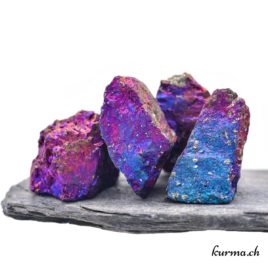
Bornite, variegated copper, erubescite
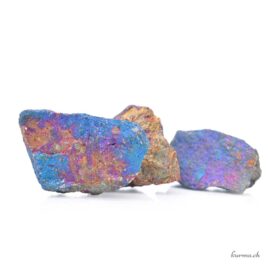
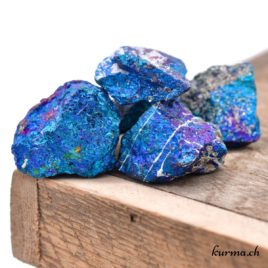
Its iridescent colors come from the oxidation of the metals it contains: copper ( khalkos in Greek) and iron ( pyrite, meaning “fire”).
In crystal healing, chalcopyrite is a stone whose properties promote learning, memory, self-confidence, and the opening of the chakras.

Chalcopyrite
cold flame
Deep gold, oxidized iron and copper
The shadows shimmer like a smoldering fire
Golden sulfides split by flashes of light
Their reflections open up a space within one’s thoughts
A calm and true vision rises from the embers
A solar presence, simple and full
It reveals itself without burning
Chalcopyrite
cold flame
Deep gold, oxidized iron and copper
The shadows shimmer like a smoldering fire
Golden sulfides split by flashes of light
Their reflections open up a space within one’s thoughts
A calm and true vision rises from the embers
A solar presence, simple and full
It reveals itself without burning
Chalcopyrite
cold flame
Deep gold, oxidized iron and copper
The shadows shimmer like a smoldering fire
Golden sulfides split by flashes of light
Their reflections open up a space within one’s thoughts
A calm and true vision rises from the embers
A solar presence, simple and full
It reveals itself without burning
Chalcopyrite
cold flame
Deep gold, oxidized iron and copper
The shadows shimmer like a smoldering fire
Golden sulfides split by flashes of light
Their reflections open up a space within one’s thoughts
A calm and true vision rises from the embers
A solar presence, simple and full
It reveals itself without burning
What are the properties and virtues of Chalcopyrite in lithotherapy?
Symbols of abundance and healing
In ancient times, Chalcopyrite was often a symbol of wealth and abundance. Its curative virtues were also undisputed by the ancient Egyptians, who used it in oil form due to copper's fungicidal properties.
Stone of the Month for August
Because of its golden luster, its solar symbolism, and its role in promoting mental clarity—all three of which evoke the brightest time of the year— chalcopyrite is associated with the month of August in crystal healing.
Energetic, soothing properties to boost self-confidence
In lithotherapy, Chalcopyrite is renowned as a stone that can help unblock the third eye and crown chakras, releasing energy blockages to relieve anxiety and enhance a calmer perception of the world through meditation and connection to others. Self-confidence is enhanced by a mind more open to optimistic thoughts.
Learning and memorization
In crystal healing, chalcopyrite is seen as beneficial for the brain’s potential: by improving blood circulation in this area, it stimulates the nervous system, leading to greater mental alertness and cognitive ability, as well as improved reflexes and memory.
From this perspective, it is considered the ideal stone for anyone with learning difficulties or trouble concentrating. By fostering self-confidence and belief in one’s abilities, it recognizes the value of imagination and encourages creativity. It is the perfect companion for children struggling in school, those who have a hard time making friends, or those preparing for exams or working on major research projects.
Physical effects
There is no scientific evidence for the physical effects of chalcopyrite; in crystal healing, it is traditionally regarded as a beneficial stone for anyone with DYS disorders—those related to hyperactivity and/or hypersensitivity.
From this perspective, chalcopyrite is also said to have antimicrobial and anti-inflammatory properties, supporting the immune system and helping to fight infections.
It may also improve the flow of energy within the body and help dissolve emotional blockages and tension.
How to use Chalcopyrite
Carry a Chalcopyrite in your pocket for greater self-confidence in everyday life.
Chalcopyrite on the solar plexus chakra can help dissolve tensions that prevent you from feeling your joie de vivre.
Looking for inspiration? Place your stone directly on your 3ᵉ eye or above your head for a moment of relaxation.
Where to place Chalcopyrite?
Placing a chalcopyrite in your living space invokes creative energies that open your mind and foster new ideas.
On your desk, it will stimulate your intellect and make your research easier. In your studio, it will be your muse.
Place a chalcopyrite in your child’s backpack or pocket to help them learn and fit in at school.
Which crystals amplify the virtues of Chalcopyrite in lithotherapy?
To enhance the effects of chalcopyrite, you can pair it with sunstone or citrine for more energy and vitality.
With pyrite, for prosperity and to attract abundance
With smoky quartz for its protective properties.
On the Hardness of Chalcopyrite and Its Association with Other Stones
Chalcopyrite has a hardness of 3.5 to 4 on the Mohs scale (it is a soft stone). Among the stones we recommend pairing it with, it can be scratched by Sunstone (6 to 6.5), Pyrite (6 to 6.5), and Smoky Quartz (7). Be sure to handle your gemstones with care!
Reload and clean
How do you cleanse chalcopyrite?
With a soft, damp cloth and immediate drying / form waves (Flower of Life or sacred geometries) / smudging (sage, benzoin, palo santo) / resting on a druse, cluster, or geode of amethyst or quartz / singing bowl, Tibetan bells, or tuning forkCare to avoid
Chalcopyrite, a copper-iron sulfide, oxidizes, stains, and may deteriorate when exposed to water or salt. / Abrasive and chemical products / Direct sunlight can accelerate oxidation and dull the iridescence / Prolonged contact with damp skin due to the risk of oxidation.
Chakras
Manipura — Solar Plexus (Chakra: Maṇipūra)confidence, self-assurance, clear vision
Ajna (third eye)
mental clarity, inner vision
Astrological signs
Lionsolar energy, confidence, personal charisma
Aries
determination, courage, inner fire.
Sagittarius
determination, growth, clear vision
Element
Lightmental clarity, peace of mind
Chalcopyrite mineralogy
It is a copper-iron sulfide found primarily in hydrothermal veins, near minerals such as sphalerite and pyrite.
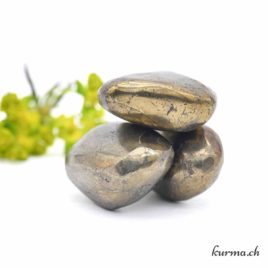
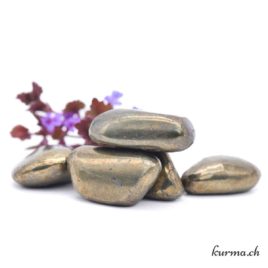
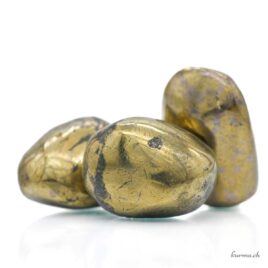
Its purple and blue colors result from the oxidation of the metals it contains. It can also appear yellow-bronze in color with iridescent highlights.
Native to Mexico, Peru, and Australia, it is also mined for the small amounts of gold it may contain.
Chalcopyrite has a hardness of 3.5 to 4.3 on the Mohs scale: it is a relatively soft mineral that must be handled with care to avoid scratching it with harder substances.
Lithotherapy
Mineralogy
- Hardness :
- 3.5-4.0
- Moths scale:
- 3, 4
- Strunz classification :
- Sulfides and Sulfosalts
- Crystalline system :
- Tetragonal
- Chemical element :
- Cu, Fe, S, Ag, Au
- Line color :
- Black (greenish)
- Density :
- 4.1-4.3
- Cleavage :
- Imperfect
- Fracture:
- Conchoidal, uneven
- Transparency :
- Opaque
- Colors :
- Golden yellow, brass yellow
- Magnetism :
- yes
- Radioactivity :
- no
Continue your visit
*Please note! Some minerals may be toxic and must not be licked or ingested (as such or in the form of powder, elixir or stone water) or be in prolonged contact with the skin or mucous membranes.
*The information on the stones described here are general indications based on our research and experience, and are not exhaustive.
Reproduction in whole or in part of this content is prohibited. More info
